
BLUEPRINT
Equity Partners

Access the March 2026 Bulletin

Vol. I · Issue 3 March 2026 Special AI Edition

THE BLUEPRINT BULLETIN

Technical Intelligence for Portfolio Leaders
Enterprise Software AI & Operations Growth Strategy
🔥 Agentic AI Market → $52B by 2030 📉 Top Model Hallucination Rate: 0.7% 📈 40% of Enterprise Apps to Embed AI Agents by Dec 2026 🚀 96% Reduction in AI Error Rates Since 2021

Blueprint Equity Launches Technical & AI Ops Resources for Portfolio Companies

A new strategic capability designed to help bootstrapped B2B software companies harness AI to accelerate product development, reduce costs, and outpace competitors

AI-powered development teams

The new era of AI-augmented development is reshaping how portfolio companies build and ship products.

Blueprint Equity is expanding its portfolio support capabilities with a dedicated Technical and AI Operations practice — a first-of-its-kind resource designed specifically for bootstrapped and lightly capitalized enterprise software companies navigating the most significant technology shift in a generation.

The new practice provides hands-on support across three critical pillars: AI-augmented product development, helping engineering teams integrate AI coding assistants and agentic workflows that are demonstrably cutting development cycles by 30–50%; AI product strategy, guiding companies on when and how to embed AI capabilities into their existing software products; and operational AI infrastructure, deploying intelligent automation across customer support, data pipelines, and internal operations.

"The companies in our portfolio have exceptional domain expertise and product-market fit," said Blueprint Equity. "What many need now is a technical co-pilot to help them move fast on AI — without the cost or risk of hiring a full AI team from scratch. That's exactly what this practice delivers."

Unlike traditional consulting engagements, Blueprint's Technical & AI Ops team works as an embedded extension of each portfolio company's engineering organization, bringing battle-tested playbooks for implementing agentic development workflows, evaluating AI vendors, and shipping AI-enhanced features that drive measurable customer value.

◆ ◆ ◆

Six Months That Changed Everything

From September 2025 to March 2026, the AI industry crossed critical thresholds in reliability, capability, and enterprise adoption that are reshaping software development at every level

96%
Hallucination
Reduction Since 2021
0.7%
Best-in-Class
Hallucination Rate
40%
Enterprise Apps
w/ AI Agents by EOY
$52B
Projected Agent
Market by 2030
AI error rate trends

The Reliability Revolution: AI Error Rates Plummet

The most dramatic story of the past six months isn't a flashy product launch — it's a quiet, relentless march toward reliability. The best-performing language models have driven hallucination rates from 21.8% in 2021 to just 0.7% in early 2025, a 96% reduction that has fundamentally altered the risk calculus for enterprise AI adoption.

Four models now operate below the 1% hallucination threshold on standardized benchmarks, with Google's Gemini 2.0 Flash leading the pack. Meanwhile, some models saw up to a 64% drop in hallucination rates in a single year. This isn't incremental improvement — it's a phase change.

For B2B software companies, this means AI features that were too risky to ship 12 months ago are now production-ready. Customer-facing AI assistants, automated document analysis, intelligent data extraction — all of these use cases have crossed the reliability threshold that enterprise buyers demand.

The Agentic Explosion: From Chatbots to Autonomous Systems

If 2024 was the year of the chatbot, 2025-2026 is definitively the year of the agent. Gartner projects that 40% of enterprise applications will embed AI agents by the end of 2026, a staggering leap from less than 5% in 2025. The agentic AI market is projected to surge from $7.8 billion to over $52 billion by 2030.

What's driving this? Three converging forces:

1. Model Capability. Models like OpenAI's o3 and o4-mini, GPT-5, and Claude now have native reasoning and tool-use capabilities that make multi-step autonomous workflows practical — not just possible.

2. Infrastructure Maturity. Frameworks for agent orchestration (LangGraph, CrewAI, AutoGen) have stabilized, making it far easier to build, test, and deploy multi-agent systems.

3. Proven ROI. Early enterprise adopters are reporting 30-50% reductions in development time, 60%+ automation of repetitive knowledge work, and significant cost savings in customer operations.

"The companies that embrace agentic development now aren't just getting a productivity boost — they're building a compounding advantage that will be nearly impossible for laggards to close."

Industry Analysis, Q1 2026
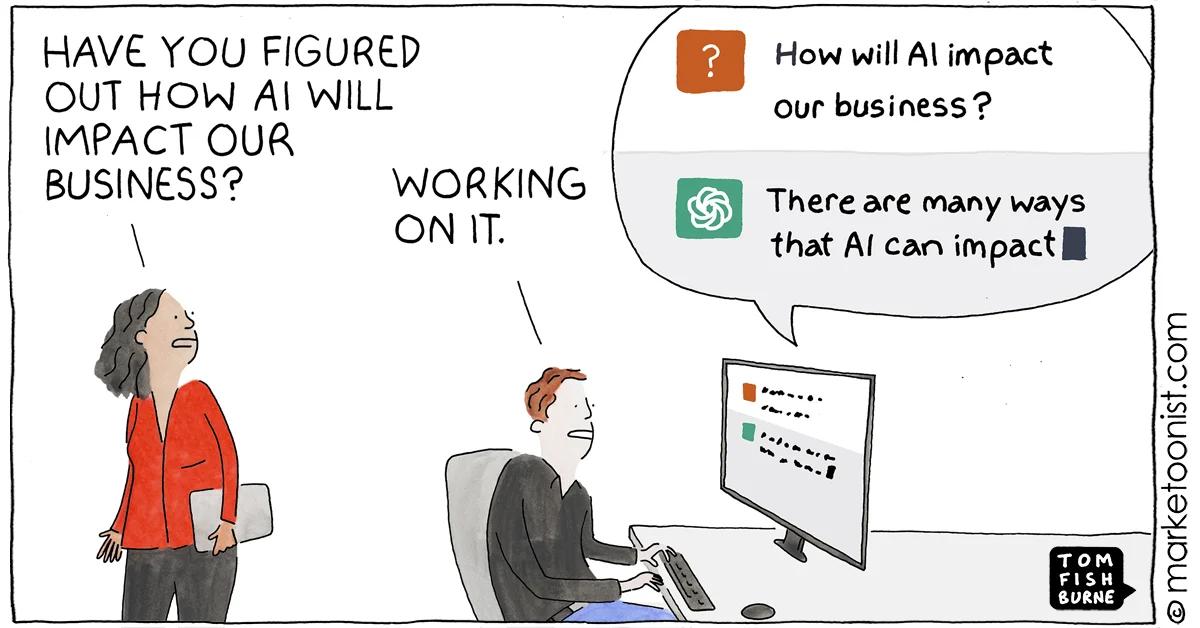
Marketoonist comic — How will AI impact our business?

© Tom Fishburne / Marketoonist.com

◆ ◆ ◆

Why Your Engineering Team Needs to Embrace Agentic Development — Now

The gap between AI-native development teams and traditional teams is widening every month. Here's what portfolio leaders need to understand.

The conversation around AI in software development has shifted from "should we use it?" to "how far behind are we?" Engineering teams that have adopted agentic development workflows — where AI agents handle code generation, testing, refactoring, documentation, and deployment tasks with increasing autonomy — are shipping faster, with fewer bugs, and at lower cost.

This isn't about replacing developers. It's about amplifying their highest-value work. A senior engineer paired with well-configured AI coding agents can operate with the throughput of a small team, while maintaining the architectural vision and domain expertise that makes great software.

The Agentic Development Stack in 2026:

AI Coding Assistants (Cursor, GitHub Copilot, Windsurf) — context-aware code generation integrated directly into the IDE, now handling 40-60% of routine code
Autonomous Coding Agents (Claude Code, OpenAI Codex, Devin) — agents that can independently implement features, fix bugs, and open pull requests from natural language descriptions
Automated Testing Agents — AI systems that generate comprehensive test suites, identify edge cases, and maintain test coverage as code evolves
CI/CD Intelligence — agentic systems that monitor deployments, auto-triage failures, and even auto-fix common pipeline issues
Documentation Agents — automated generation and maintenance of API docs, changelogs, and internal knowledge bases

The compounding effect is what makes this urgent. Teams that start now build institutional knowledge in AI workflows, develop internal prompt libraries and agent configurations tuned to their codebase, and attract talent that increasingly expects AI-native tooling. Teams that wait will face a growing productivity gap and a harder time recruiting top engineers who've experienced agentic development.

"We went from a 3-week sprint cycle to shipping meaningful features in 5-7 days. The AI handles the boilerplate; our engineers focus on the hard problems."

CTO, Blueprint Portfolio Company
◆ ◆ ◆

What's Happening with AI in Your Space

A competitive analysis of AI adoption and innovation among home improvement CRM & estimating platforms — the direct competitors to Builder Prime

Construction technology

The home improvement software sector is entering an AI arms race — and the early movers are gaining ground.

The construction and home improvement CRM space is experiencing its own AI inflection point. Across Builder Prime's competitive landscape, companies are racing to embed AI capabilities that automate estimating, personalize customer communication, predict lead quality, and optimize production scheduling. Here's how the field is shaping up:

Company AI Focus Areas AI Maturity Key Moves
JobNimbus Automated workflows, AI-powered lead scoring, smart task routing High Heavy investment in automation engine; AI features increasingly central to value prop
Jobber AI scheduling optimization, smart quoting, automated follow-ups High Raised $100M+; expanding AI across scheduling and client communication
AccuLynx Aerial measurement AI, automated material ordering, photo analysis Medium Deep integration with EagleView for AI-powered roof measurements
Buildertrend AI project forecasting, intelligent resource allocation, automated reporting High Acquired by RealPage; leveraging parent company's AI/ML capabilities at scale
Leap Digital sales process, AI-assisted estimate generation, smart contract workflows Medium Focused on digitizing the in-home sales experience with AI-powered pricing
MarketSharp Marketing automation, predictive lead scoring, customer segmentation Low Legacy platform; slower AI adoption compared to newer entrants
Procore AI safety analysis, predictive project analytics, document AI, resource optimization High Massive R&D budget; building AI into every layer of the construction management stack
ServiceTitan AI dispatching, dynamic pricing, conversational AI for booking, predictive demand High Post-IPO; aggressively deploying AI across trades verticals, including home improvement

Key Takeaways for Builder Prime

1. The AI Table Stakes Are Rising
Competitors like JobNimbus, Jobber, and ServiceTitan are making AI a core differentiator, not a nice-to-have. Automated lead scoring, AI-powered scheduling, and intelligent workflow automation are quickly becoming expected features. Companies without meaningful AI capabilities risk looking dated in sales demos.

2. Vertical AI is the Opportunity
Generic AI features (chatbots, basic automation) don't move the needle. The winners in this space are building deeply vertical AI that understands construction-specific workflows — estimating from blueprints, material optimization, crew scheduling around weather patterns. This is where domain expertise creates durable competitive advantage.

3. AI-Powered Estimating is Ground Zero
The ability to generate accurate estimates faster is the single highest-value AI application in this sector. Companies integrating computer vision (aerial measurements), historical pricing data, and material databases into AI-assisted estimating tools are winning larger contractors and reducing sales cycle friction.

4. The Consolidation Factor
Well-funded competitors (Buildertrend/RealPage, ServiceTitan post-IPO) have significant AI R&D budgets. Bootstrapped competitors need to be strategic — leveraging modern AI infrastructure (pre-trained models, API-based AI services) to build competitive features without needing massive teams.

◆ ◆ ◆

What Happened in AI: February 2026

The month's most important developments, curated for enterprise software leaders

Models & Capabilities

Claude Opus 4 launched with extended thinking and near-perfect coding benchmarks, raising the bar for AI-assisted development

Google Gemini 2.5 Pro expanded its 1M-token context window with improved long-document reasoning

GPT-5.1 refinements delivered measurable improvements in instruction following and reduced hallucination rates by another 15%

Open-source models (Llama 4, Mistral Large 2) closed the gap with proprietary models on enterprise benchmarks, giving companies more deployment flexibility

Agentic & Infrastructure

Anthropic's Claude Code and OpenAI's Codex agents shipped major updates enabling multi-file autonomous coding sessions with human oversight

Microsoft integrated Copilot Agents across the entire M365 suite, bringing AI automation to enterprise workflows at massive scale

Gartner reaffirmed its prediction: 40% of enterprise apps will embed AI agents by end of 2026

MCP (Model Context Protocol) gained rapid adoption as the standard for connecting AI agents to external tools and data sources

Business Impact

AI spending by enterprises projected to exceed $200B globally in 2026, with the fastest growth in AI-augmented software development

Talent market shifting: "AI-native" developers (those proficient with AI tools) command 15-25% salary premiums over traditional developers

ROI studies from McKinsey and BCG show AI-augmented dev teams deliver 40-55% faster time-to-market with comparable or better code quality

Regulatory landscape: EU AI Act enforcement begins, requiring AI transparency and documentation for high-risk applications

THE BLUEPRINT BULLETIN

Published monthly by Blueprint Equity · Technical Intelligence for Portfolio Leaders

For inquiries or to schedule a Technical & AI Ops briefing: onblueprint.com/contact

© 2026 Blueprint Equity. All rights reserved. This newsletter contains proprietary market intelligence intended for authorized recipients only.